
Illustration for the 2025 Bus Festival, with three vintage buses and people enjoying them, with orange, green, yellow, and purple imagery.

About the Vehicles

This year’s Bus Festival featured some of the most iconic buses in the Museum’s collection, as well as vehicles from MTA Bridge & Tunnels and MTA Paratransit. Lovingly maintained and operated by MTA New York City Transit, each bus offers a chance to experience New York City’s transit evolution firsthand.

Please note: Equipment is subject to change.
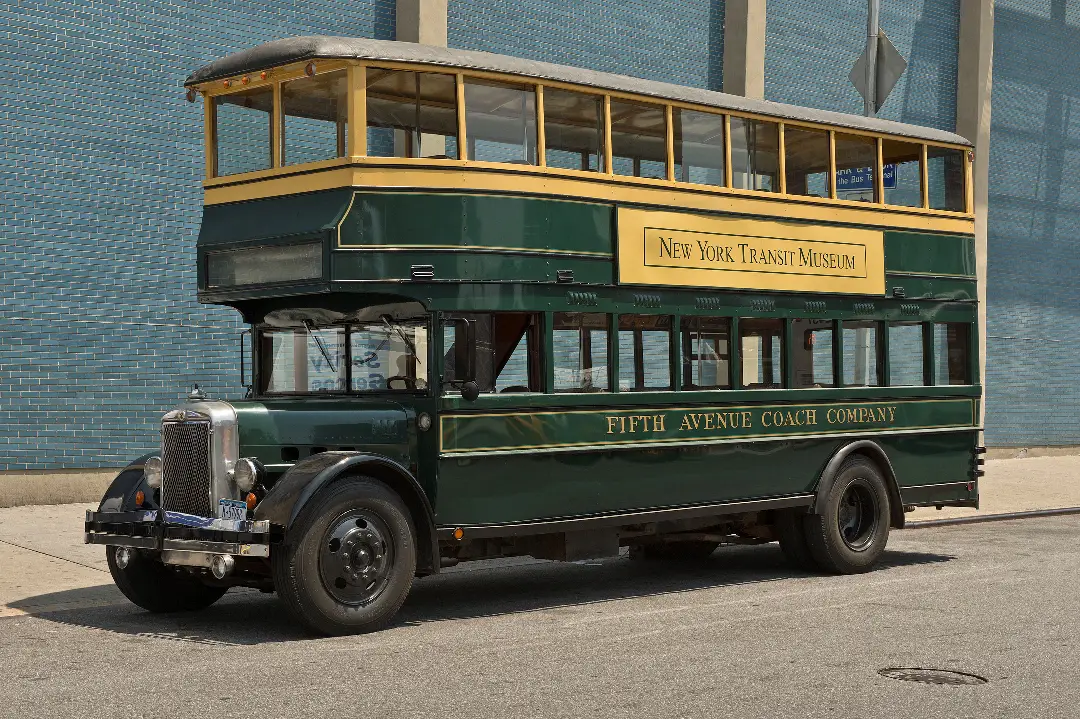
A vintage yellow and green double decker bus, one of the oldest buses in the New York Transit Museum's fleet.
“Betsy” (1931)

Bus #1263 was part of Fifth Avenue Coach’s “1200 series”—a fleet of 100 Yellow Coach “Z-type” buses manufactured in 1930. This series included two slightly different chassis models, the 602 and 632, and three body styles: open-top (40 buses), semi-enclosed (4 buses), and fully enclosed (56 buses). Bus #1263 was one of the 52 enclosed model 602 buses in the order.

The 1200-series buses were among the last front-engine double-deck buses built by Yellow Coach. In 1936, the Fifth Avenue Coach Company introduced a new rear-engine, a more streamlined design. Bus #1263 remained in Manhattan passenger service until 1947, and the company phased out all double-decker operations by 1953. Known lovingly as “Betsy,” Bus #1263 is one of the oldest in our vintage fleet.

  • Manufacturer: Yellow Coach Company, Model: Z-BH-602
  • Operator: Fifth Avenue Coach Company
  • Service: Fifth Avenue Routes, Manhattan
  • Dimensions: 29.667’ length, 8’ width, 14.208’ height

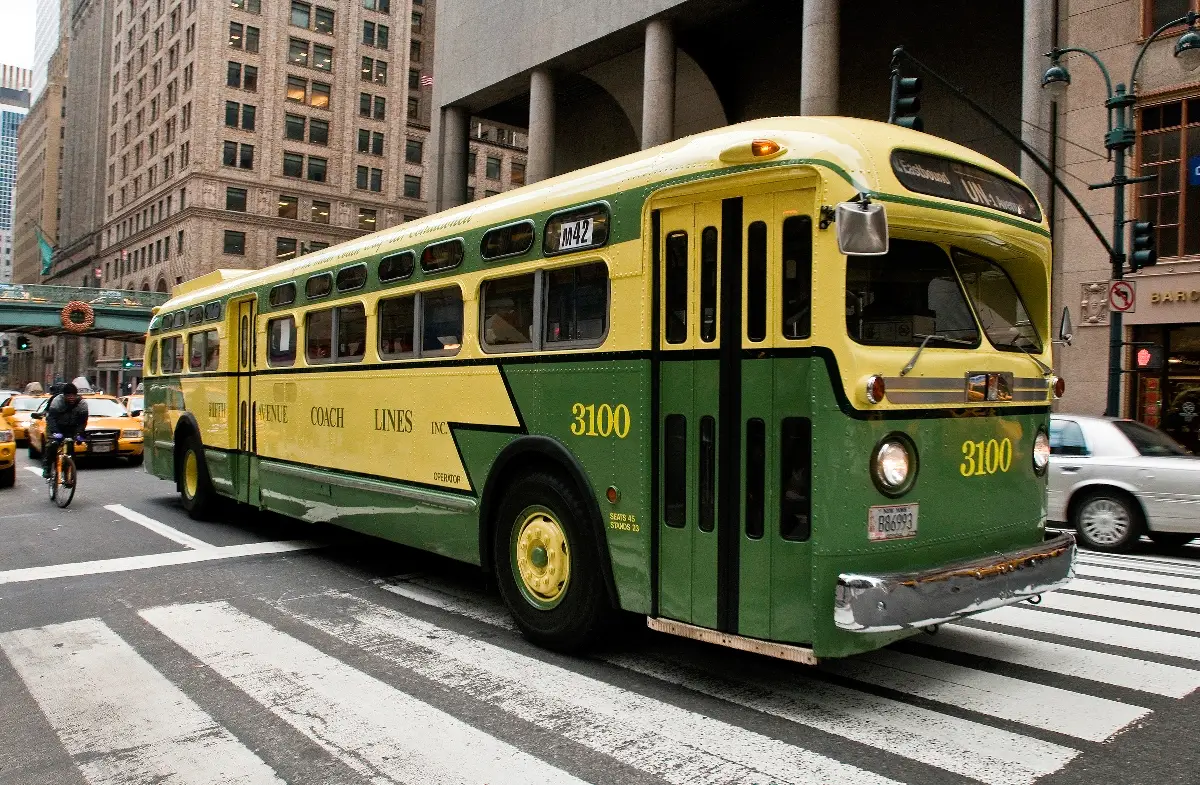
Bus 3100, a yellow and green stunner that features innovations introduced in the 1950s, including a push-type rear exit door, wrap-around seating in the rear, soft cushioned seats, and fluorescent lighting.
Bus #3100 (1956)

Manufactured by General Motors, Bus #3100 was the first air-conditioned bus in the United States. Originally built as an experimental model (TDH-5106), it was purchased by the Fifth Avenue Coach Company about a year after production.

Between 1958 and 1968, it served Fifth Avenue on the M4 and M5 routes in Manhattan. Bus 3100 features innovations introduced in the 1950s, including a push-type rear exit door, wrap-around seating in the rear, soft cushioned seats, and fluorescent lighting.

  • Manufacturer: General Motors Corporation, Model 5106
  • Operators: Fifth Avenue Coach Company & Manhattan and Bronx Surface Transit Operating Authority (MaBSTOA)
  • Service: Fifth Avenue, M4 & M5 routes, Manhattan, 1958-1968
  • Dimensions: 40’ length, 8’ width

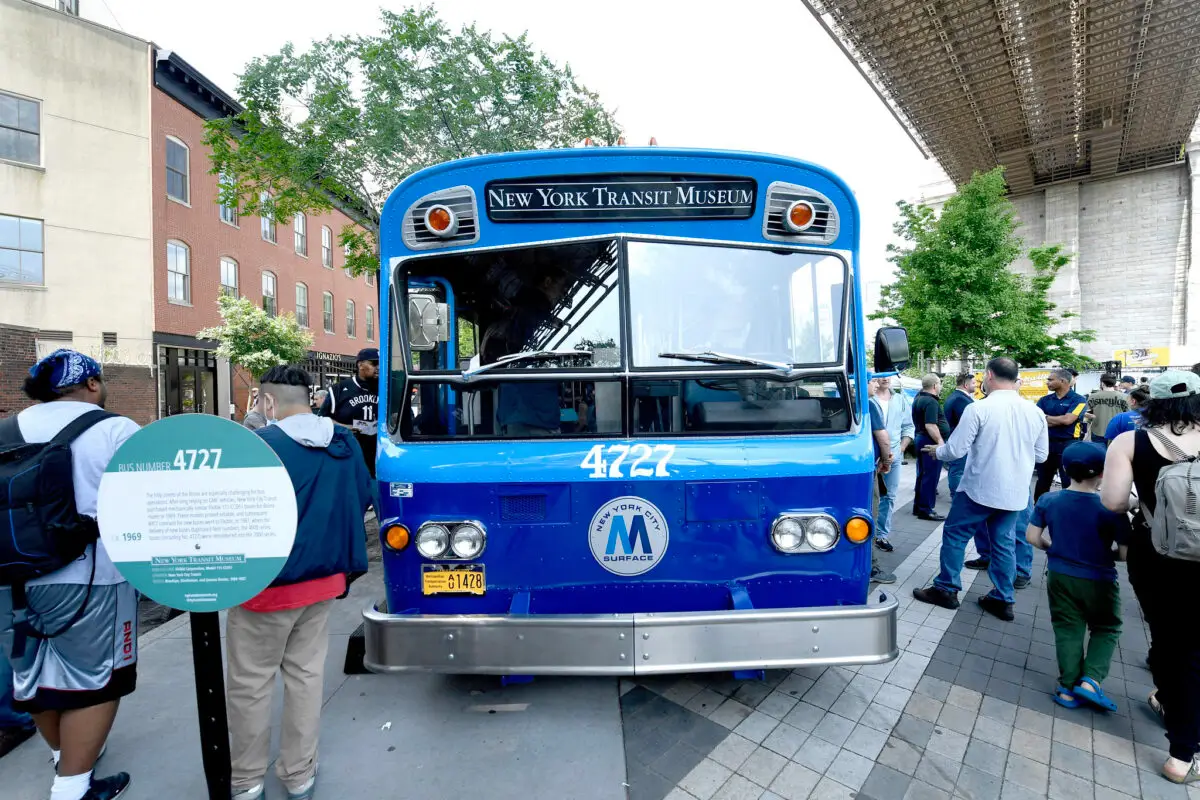
Bus 4717 has been restored to its iconic 1970s blue livery and two one M logo.
Bus #4727 (1969)

Built in 1969 by the Flxible Corporation, Bus #4727 (Model 1110D51) marked a shift from the long-standing tradition of operating only GMC buses in the Bronx. The Manhattan and Bronx Surface Transit Operating Authority (MaBSTOA) purchased these Flxible 111-CCD51 models for their ability to handle the borough’s steep hills, and they proved to be dependable workhorses. Their success led to additional contracts with Flxible in the years that followed. In 1987, when new buses arrived with duplicate fleet numbers, the original 4000-series buses (including No. 4727) were renumbered into the 7000 series. Today, Bus #4727 has been restored to its iconic 1970s blue/blue livery.

  • Operator: New York City Transit
  • Dimensions: 40’ length, 102 inches wide

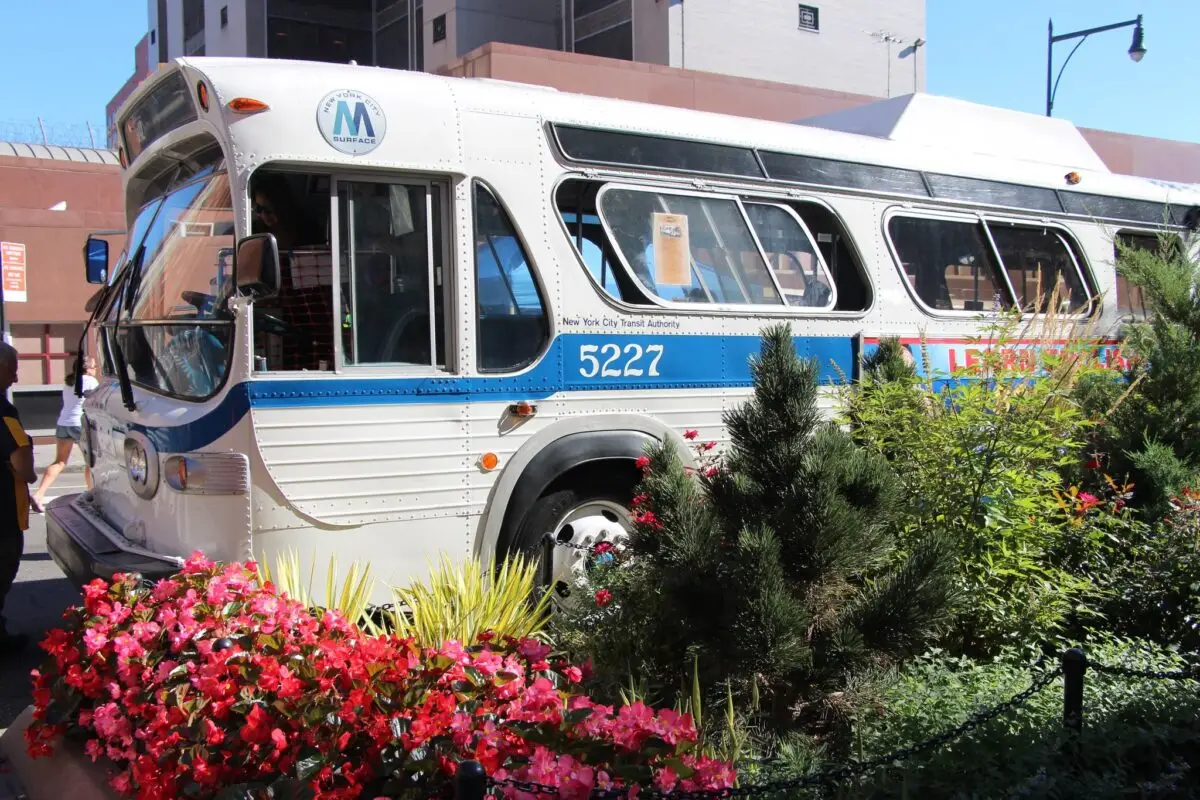
Bus 5227 nestled next to a garden in Brooklyn. These buses were quick and featured white and blue colors with hard blue lengthwise seating.
Bus #5227 (1971)

Bus #5227 entered service in 1971 as part of the General Motors “New Look” fleet. In 1984-85, 350 of these buses were sent to the Blitz Corporation in Chicago for a complete overhaul and rebuild. Upon their return to New York City—renumbered in the 5000-series—they became known as “Blitz Buses.”

These updated buses featured hard, blue lengthwise seating and were the last model in the NYCT fleet not equipped with a wheelchair lift. Bus #5227 was retired from service in 1995.

  • Manufacturer: General Motors, Model 5305A, remanufactured by Blitz Corporation
  • Operator: New York City Transit Authority
  • Service: Brooklyn, Manhattan, Queens, and Staten Island routes, 1971-1995
  • Dimensions: 40’ length, 8.5’ width

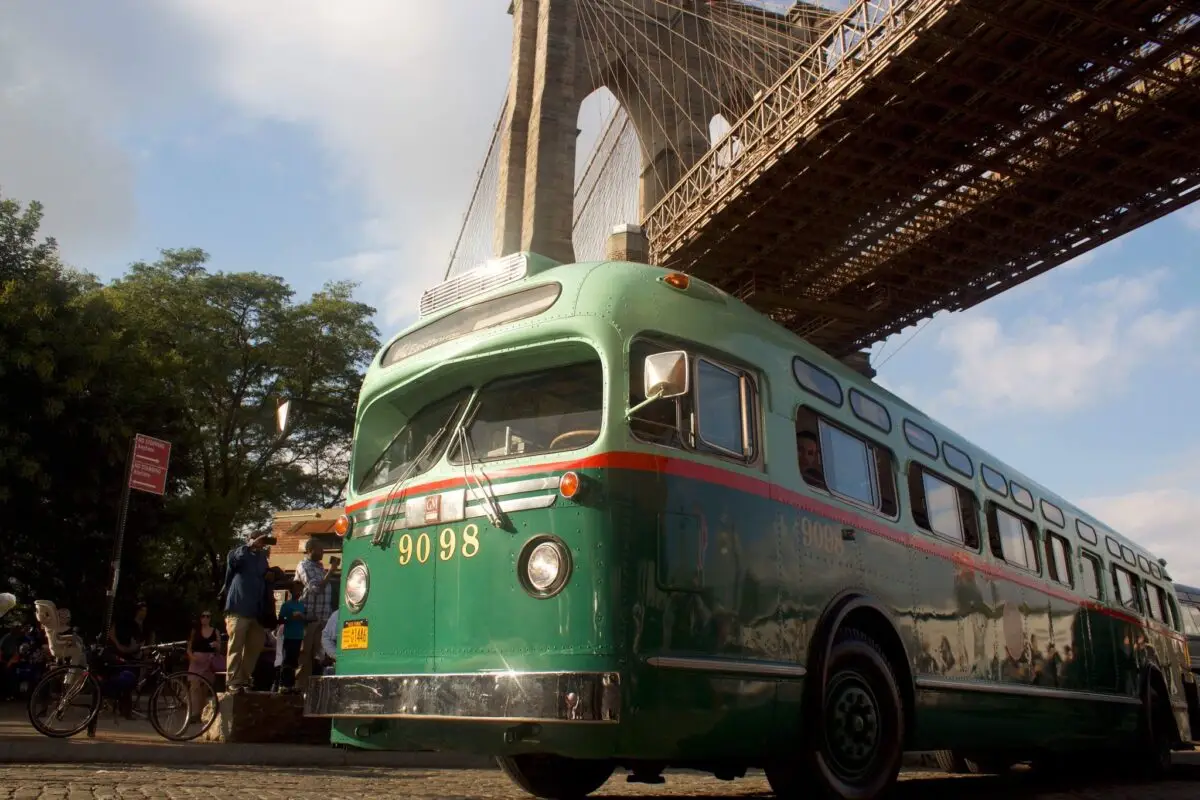
Bus 9098 sports a two-tone green exterior with a contrasting stripe, and was also the first type of bus in New York City equipped with sliding windows, fiberglass seats, and rear door safety exits.
Bus #9098 (1958)

This bus was the first model to sport a two-tone green exterior with a contrasting stripe, and was also the first type of bus in New York City equipped with sliding windows, fiberglass seats, and rear door safety exits. This innovative system substituted two panel doors for the accordion-type rear doors and interfaced with the bus braking system. Bus #9098 is an “old look” bus, which has been likened to a PCC streetcar, or a loaf of sandwich bread.

  • Manufacturer: General Motors Corporation, Model 5106
  • Operator: New York City Transit Authority
  • Service: Built 1953-1959 in service 1958-1971
  • Dimension: 40’ length, 8.5’ width

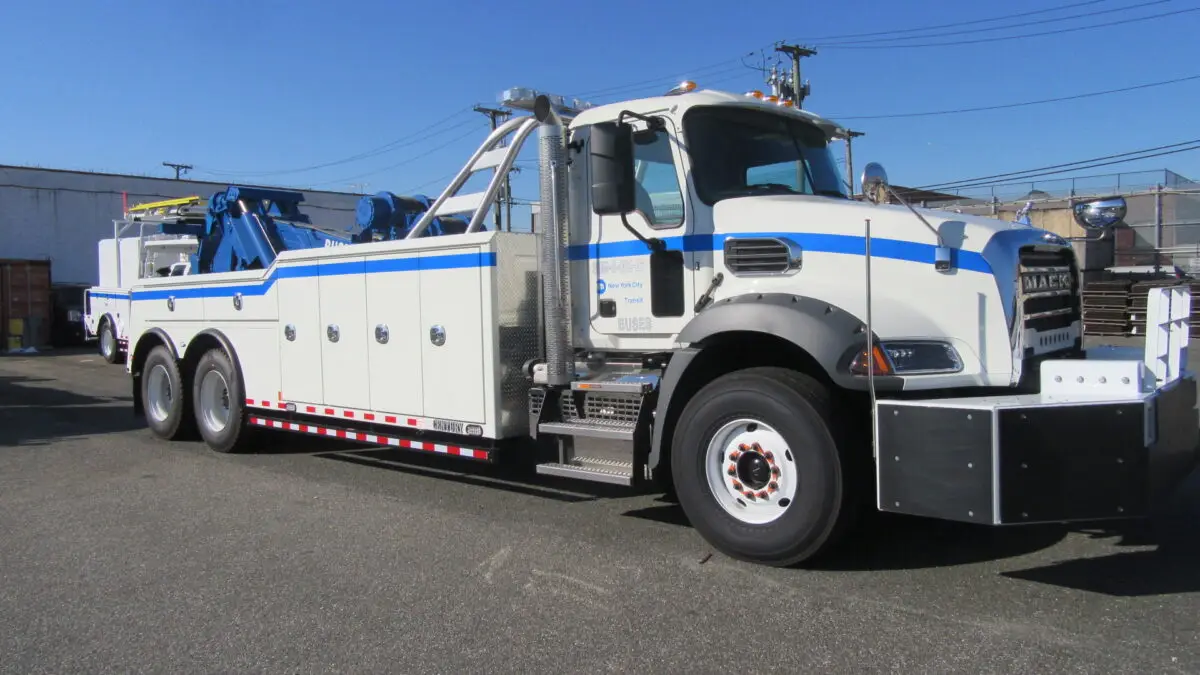
White bus tow truck with a large blue strip.
Bus Tow Truck

This 50-ton wrecker built by Miller Industries is one of the newest road operations vehicles in the fleet.  It is equipped with an under-lift, which has an operable reach of 129” reach, LED lights, a flat screen color monitor, reverse camera and a composite heavy duty tow truck body construction.  It went into service in September 17, 2025 and operates out of Casey Stengel Depot in Queens.

  • Manufacturer:  Mack Truck Inc. Cab Model – Granite, Body – Century 7035 Tandem-Axle with Coach, Nova, New flyer Type Under-lift recovery equipment.
  • Operator: New York City Transit
  • Service: All boroughs and the Tri-State area, 2025

This blue and yellow electric bus is stopped on a street corner in New York City.
Electric Bus #5008-5019 (2024)

The MTA has a goal to have a 100% zero emission bus fleet by 2040. The New Flyer XE40 (also known as a New Flyer Xcelsior) is one of the buses that will help the Authority meet that goal. It is a 40 foot electric bus that has a range of 254 miles per full charge, and a top speed of 65 miles per hour. They also feature regenerative braking, which means when the brakes of the bus are applied, the energy that would have normally been lost as heat is harvested and fed into energy storage — in the case of the XE40, it’s a battery. The battery stores the energy until it can be used as propulsion (forward motion). The MTA began using XE40 buses in 2022. They are currently used on several routes in the city.

  • Manufacturer: 2024 New Flyer, Model XE40
  • Operator: MTA New York City Transit

The yellow white and blue minibus has been converted to hold wheelchairs and ambulatory seats.
Van #6237 (2024)

Van #6237 is a Flex DRW minibus that has been converted to hold wheelchairs and ambulatory seats. The “DRW” stands for “Dual Rear Wheel” – a configuration that increases the surface area of the tires that touch the ground without bulging out as much as a single tire, which reduces pressure. It is also more cost-effective, and makes it easier to replace the tires if one gets punctured.

Bus #6298 (2023)

Bus #6298 is a Ford E-Transit cargo van that’s been converted to hold wheelchairs and ambulatory seats. It is an electric van with an enhanced battery, so it has an extended range to reduce the need for frequent charging. The Paratransit fleet has 10 all-electric vehicles in its pilot program. Each electric van has a range of 90 to 100 miles and 8 to 10 hours of service on a single charge, enabling completion of a route before charging is needed.

\
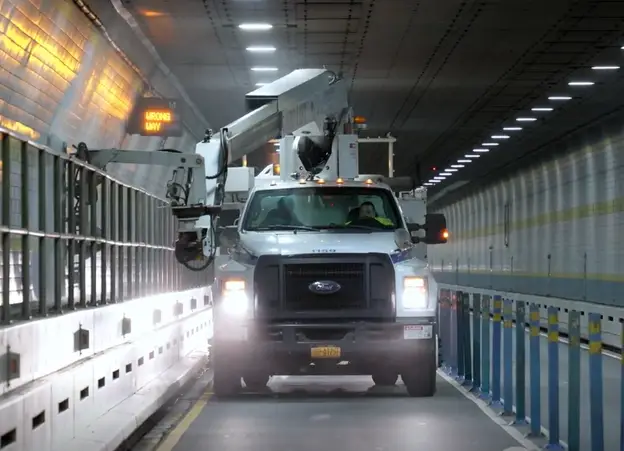
Tunnel Scrubber

The tunnel scrubber is used to clean tunnel walls and ceilings simultaneously. Vehicle emissions and dirt build up on tunnel surfaces and need to be cleaned regularly. As the truck makes its way through the tunnel there are 5 scrub brushes that spin and spray a cleaning solution. The back of the truck has spray nozzles to rinse off the dirt and cleaning fluids.

The vacuum truck is custom built: a Vac-Con vacuum unit on a 2021 Mack GR64F. It is primarily used to clean drains, manholes, scuppers and catch basins on bridges, tunnels, and roadways.
Vacuum Truck (2021)

The vacuum truck is custom built: a Vac-Con vacuum unit on a 2021 Mack GR64F. It is primarily used to clean drains, manholes, scuppers and catch basins on bridges, tunnels, and roadways. This large, super-powered vacuum makes short work of any obstacles that impede the safe drainage of water from structures.

SUPPORT
THE MUSEUM

Thank you for joining us for Bus Festival 2025! Make a donation to help restore and maintain our vintage buses, subway and elevated cars. Your gift will help save a seat for the next generation.